
 Write a comment
It isn't working and isn't meant to IMO. It's the pathway of Agenda 2030 which aims to have us all moving to the (not) smart cities so let's make it difficult and expensive to maintain an existence in the rural areas. Weather warfare does it nicely. Flooding being one of the globalists' tools. Quakes and fires are the other ones. Disaster capitalism. It's all so obviously in your face if you know what the plan is. Guy points out a job that could've cost $5,000 and taken a couple of days instead draws a trail [gravy train?] "of assessors, geotech engineers, and valuers to grind through the costly NHC maze". Insanity. Wake up folks, to put it simply, they want your land &/or what's under it .... TWNZ
The Natural Hazards Insurance Act is not working. What this means for Kiwis.
From Guy Hatchard
Given NZ’s vulnerability to natural disasters, this article raises questions about new legislation that should be of concern to everyone.
Two weeks ago we had a flood in our house after a water pipe burst in the ceiling cavity. Within 2 days our insurance company had assessed and settled the claim. We were able to start work immediately to remedy the damage.
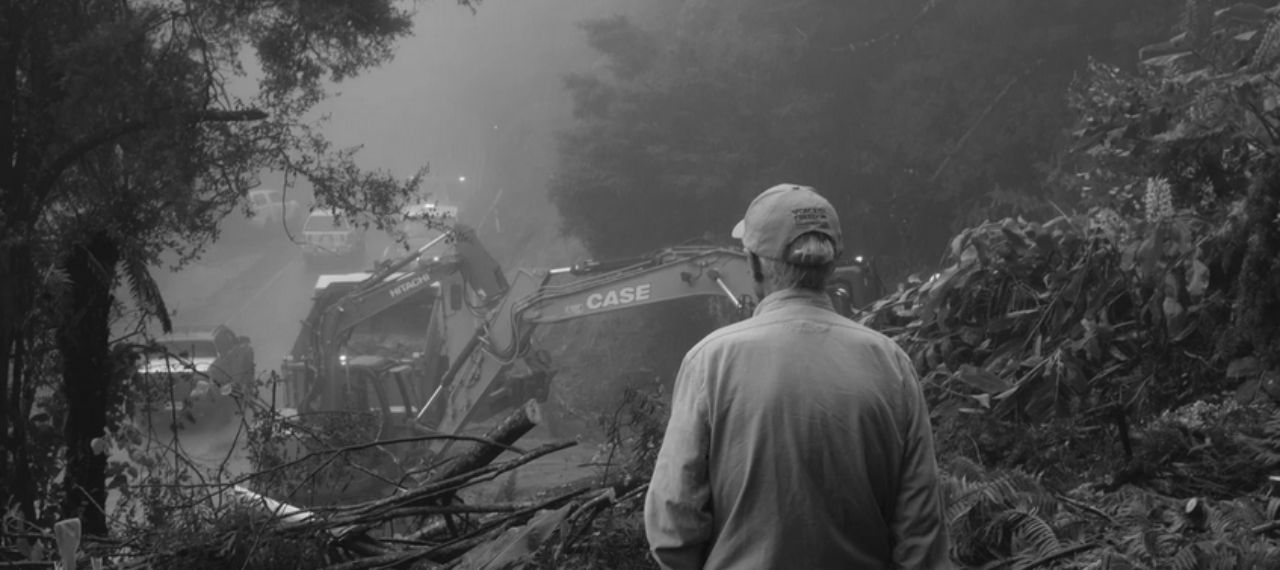
In contrast, on January 18th we suffered a devastating rain event. Over 300mm of rain triggered a landslide burying our driveway under five metres of debris and closing the adjacent Russell Road. We were just one of hundreds of properties affected in the area around Oakura in Northland. Rated as a natural disaster, all insurance claims were automatically dealt with under the provisions of the recent Natural Hazards Insurance Act. Our claim and dozens of others in the area have still not been resolved satisfactorily 133 days later.
The Natural Hazards Insurance Act (NHI) was passed in 2023. Its stated purpose is:
“to reduce the impact of natural hazards on people, property, and the community by providing for first loss insurance for residential buildings and residential land against damage that is a direct result of natural hazards”
It is intended to provide cover for damage to residential buildings and land that is a direct result of an earthquake, hydrothermal activity, a landslide, a tsunami, a storm, a flood, volcanic activity or a fire.
The Act established the Natural Hazards Commission (NHC) which imposes a 10% levy on everyone’s insurance premiums. NHC currently sits on a fund of $670 million and has $10.3 billion in global reinsurance.
It all sounds very reassuring until you actually have to make a claim and go through the tortuous process governed by an Act that appears to be written by people well versed in the art of Catch 22. If you have lived through a disaster, you will know that speed is of the essence. Following the Christchurch earthquake, our cell phones didn’t work, bridges were closed and taps ran dry. Within a day, supermarket shelves and petrol stations were largely empty.
Therefore alarm bells rang when the NHC appointed assessor arrived at our property to look at the landslip a week after the event and told us not to rush because he already knew that the complex NHI claims process would take a minimum of three months to complete.
The Act has a number of provisions which restrict NHC’s liability and severely limit the extent of any compensation.
Clearly the Act is written with city dwellers in mind, but even there the Act is deficient. Any NHC liability to restore property access is limited to 60 metres from your dwelling. In our case, and that of many rural properties, the only viable access to our property is affected, but most of it lies more than 60m from our dwelling and is therefore outside the scope of the Act. Moreover the Act caps NHC liability to the value of the proportion of the driveway affected. This is calculated as a proportional fraction of the value of the whole property. Say you have a property of 5 hectares with a land value of $500,000, with 50 square metres of driveway affected by a landslip. Using the NHC formula, you multiply 500,000 by the fraction 50/50000 which leaves the total NHC liability at just a paltry $500.
The same formula would work quite differently for a city plot of 600m2 valued at $300,000. The relevant fraction for 50m2 of damaged driveway would work out 1/12, leaving the cap at $25,000. Probably more than enough to repair a driveway, except in the case of a major slide, where the coverage would be insufficient. There are also other limitations to the Act coverage. But definitely these formulas do not work in the country. Our slip is mostly within 60 metres of a dwelling. It involved the movement of 2,500 m3 of material (300 truck loads), but most of the driveway where it ended up is just outside the 60m limit. NHC estimated the cost of repair at $337,000, but is offering just $12,700 in full settlement of its liability.
The NHC process is not only slow and unsuitable for country properties, it is very costly to implement. So far, NHC has spent more than $25,000 assessing our claim, only to tell us that their liability is limited to a tiny fraction of the damage. This has involved hiring geotechnical engineers to travel 200kms from Auckland and back in order to spend 20 minutes looking at a pile of debris and then three weeks compiling a report (there are a lot of local geotechnical firms who are very familiar with our area geology who could have been hired). We also had a site visit from a registered valuer to complete the calculations I managed in one sentence above.
We are not alone in being affected, A neighbour whose water supply was cut off but not covered by NHC put the situation succinctly: “It is as if your car is a write off and they are offering you a steering wheel”. Another neighbour, a corner of whose house foundation has slipped 20mm distorting doors and windows, is still mired in a prolonged and unsatisfactory NHC process with no outcome in sight. In the real world someone would have arrived within a week to jack up the slumped corner of the house and rectify the problem. It might have cost $5,000 and taken a couple of days to fix. Instead, the same trail of assessors, geotech engineers, and valuers are still grinding through the costly NHC maze. Moreover the corner of the house affected adds up to a single square metre, whose value will limit NHC’s liability to pennies. You don’t need me to tell you this is madness.
I wrote to the NHC pointing out that the clauses of the NHI Act contain qualifications to its limitations which are clearly intended to allow the Commission some leeway in helping those affected by a natural hazard. For example, in valuing affected land the wording of the Act says the process is supposed to take account of the ‘utility’ of the land not just the square metres affected. If there is no longer a viable safe access, surely the value of the whole property is at risk? The Commission has told us only the land under the access way is covered, despite the Act saying that land which ‘supports and protects’access should also be covered. The Act says that the process of defining liability should take account of the ‘efficacy of the solution being offered’ not just the lowest possible payout. These points and others are being ignored by the Commission, suggesting NHC has decided on a very narrow interpretation of the Act. It is hard to escape the notion that NHC’s priorities are heavily weighted towards professional services, rather than helping people affected by disasters.
This week the Natural Hazards Commission finally replied to these points summarising their response quite bluntly and without addressing the Act wording I queried:
“We have completed a full review of your claim and remain satisfied that the claim outcome is correct and in line with the Natural Hazards Insurance Act and its limitations.”
The Commission has an annual income of $870 million, it employs 310 full time staff, although virtually all of its actual work and claim management is carried out by consulting firms and companies (including public relations firms) it appoints and pays handsomely, who the Commission requires to strictly adhere to its narrow interpretation of the Act wording.
The Natural Hazards Insurance Act was supposed to fix the problems of the EQC process, it appears to be a giant retrograde step written by Wellington lawyers who had no clear idea of what a natural disaster might involve and how to swiftly manage a solution. As a result, much of the NHC levy we all have to pay is being wasted on a bureaucratic nightmare. I doubt whether many if any MPs took the time to think the matter through. I have twice requested a meeting and submitted documentation to my local Northland MP Grant McCallum who has not responded to our request. Stuff newspaper has printed a comprehensive article about our concerns which has had more than a 100,000 views which shows the workings of the Act is a matter of significant public interest. I hope this article can trigger some concerns on a wider front.
Although our NHC claim has hit a brick wall, there has been a silver lining. Whangarei District Council and their contractor Fulton Hogan have been helpful, going above and beyond the call of duty. They promptly cleared a way out of our property. They have followed up by assessing the potential future risks for us and the road. It goes to show that hazards might be better managed locally rather than by a central bureaucratic Crown entity like the NHC. At the very least the wording and provisions of the Act need amending. A great deal of our economy and cultural life depends on a safe rural environment.
Alternatively, as the 48 hour turn around of our recent domestic flood settlement shows, it might be an option to simply require insurance companies to provide hazard cover. It would be in their interests to keep processing costs down. Moreover if you were dissatisfied, unlike the compulsory NHC levy arrangement, you could always take your business elsewhere.
In a volcanic, earthquake prone country, you never know when you might need cover, Kiwis need a natural hazard insurance system that works. NZ has a can do attitude, let’s get this right.
Photo Credit: hatchardreport.com